
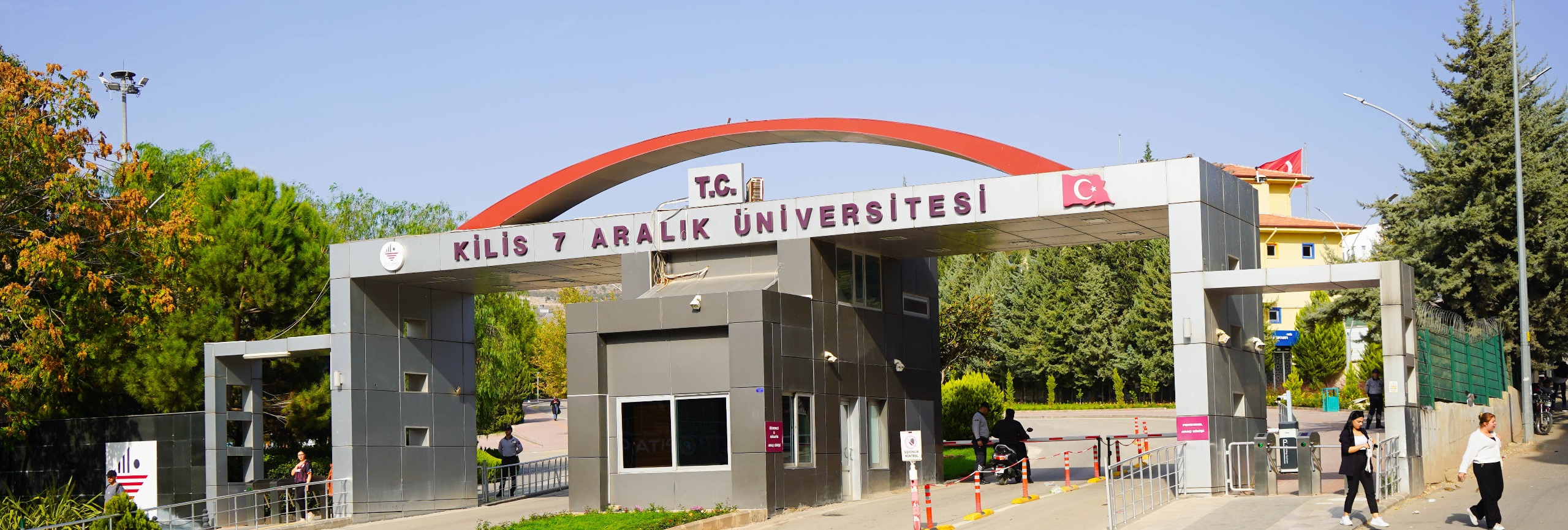
The Department of Geography at Kilis 7 Aralık University was established in 2009 and produced its first graduates in 2013. Our department comprises four main branches of science: Human and Economic Geography, Physical Geography, Regional Geography, and the Geography of Turkey. Our academic staff consists of eight members, including one Professor, four Assistant Professors, and three Research Assistants.
Geography is an interdisciplinary science that focuses on the interaction between the natural environment and humans, examining the distribution, causes, and consequences of spatial phenomena. The primary objective of our department is to train qualified geographers who can interpret the relationships between geographical events, solve spatial problems using information and technology, and master scientific methods and techniques. In Turkey, which is undergoing a rapid process of socio-spatial change and development, the work of geographers is essential for environmental and socio-spatial planning and monitoring the outcomes of services provided. Furthermore, geography is gaining even greater importance within the processes of globalization and localization.
To scientifically research natural processes in the physical environment and their spatial and temporal relationships;
To reveal the spatial and temporal characteristics of social and economic activities;
To examine the links between human activities and natural systems.
The department aims to provide students with the following key competencies:
Ensuring they graduate as qualified geographers with high research and inquiry skills, a sense of responsibility, adherence to national values, and the ability to utilize scientific knowledge and research methods, consistent with modern Geography departments;
Enabling them to present and interpret data through maps, photographs, databases, and various figures and/or charts;
Enhancing their competence in physical and human geography on both global and regional scales;
Ensuring a modern understanding of the relationship between the natural environment and human systems;
Equipping them with the necessary skills to research the effects on the natural environment in spatial and temporal dimensions and to analyze social, human, economic, and cultural processes.
General Courses: Introduction to Geography, Cartography, Computer Applications in Geography, Effective Communication and Presentation Techniques, Critical Thinking, Reading and Writing, Philosophy of Science, Digital Literacy, Scientific Research Methods and Techniques, Academic English, Spatial Statistics, Geographic Information Systems (GIS), Remote Sensing.
Physical Geography: General Geology, Geomorphology, Climatology, Vegetation Geography, Hydrography, Research Methods in Physical Geography, Soil Geography, Quaternary Geography, Geography of Disasters, Global Climate Change.
Human Geography: Economic Geography, Population Geography, Globalization and Development, Energy Resources, Industrial Geography, Settlement Geography, Urban Geography, Geography of Mines, Historical Geography, Administrative Geography, Transport Geography, Tourism Geography, Contemporary World Problems, Political Geography, The Middle East, Geography and Geopolitics, Uneven Development and Regional Development, Discussions on Space, Migration and Mobility.
Geography of Turkey: Energy Resources of Turkey, Economic Geography of Turkey, Physical Geography of Turkey, Urbanization in Turkey, Climate and Vegetation of Turkey, Geopolitics of Turkey.